Where Banks Are Using AI in Financial Crime & Compliance Today
Banks are embracing AI - that is the number one finding of our latest research with Chartis. 91% of the compliance and risk leaders that we surveyed said that their institution encourages AI use, while 70% said that AI was being tested or piloted in their organization.
The report, AI in Financial Crime and Compliance: Charting the Path from Pilot to Maturity, provides insight into current and future use of AI in banks' FCC function.
→ Download the Banking Edition here
→ Download the Payment & FinTech Edition here
How AI is used across financial crime & compliance
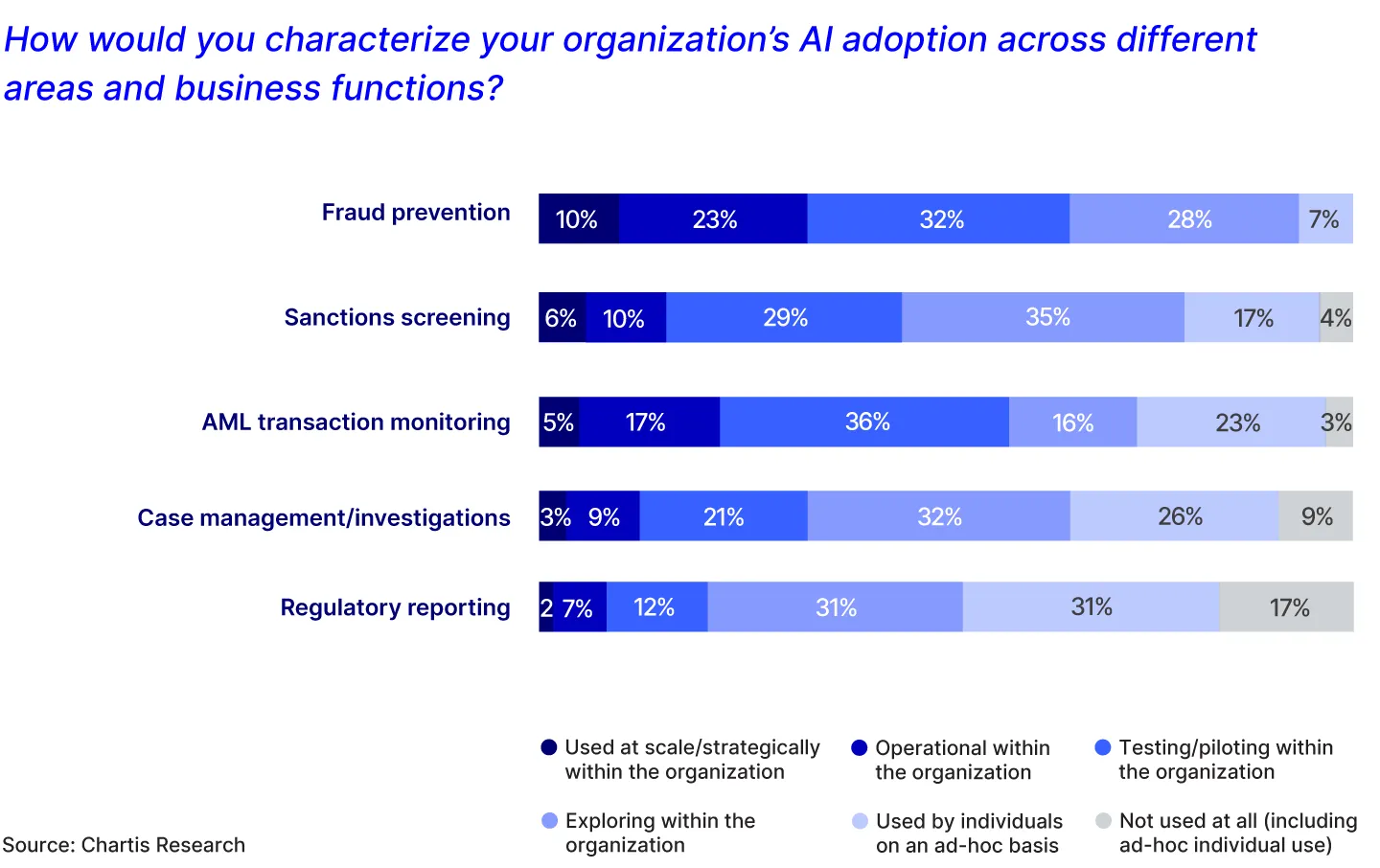
When compliance and risk leaders ranked their current AI usage across five different areas of FCC, fraud prevention emerged as the clear frontrunner:
- 33% are using AI at scale or operationally in fraud prevention
- 32% are testing or piloting AI in fraud prevention
- 28% are exploring AI for fraud prevention
- 0% of banks reported no AI usage in anti-fraud programs
AML transaction monitoring follows as the second most mature area, with 22% reporting operational or at-scale deployment. Sanctions screening stands at 16%, while case management and investigations trail at 12%.
AI maturity varies significantly across FCC, with regulatory reporting lagging furthest behind. Only 9% of banks actively use AI in regulatory reporting, while 17% do not use it at all. This represents the highest rate of non-adoption across all FCC areas.
At the same time, regulatory reporting shows the highest level of informal AI use: 31% of institutions we surveyed said individuals use AI on an ad hoc basis.
Which AI techniques different FCC functions use
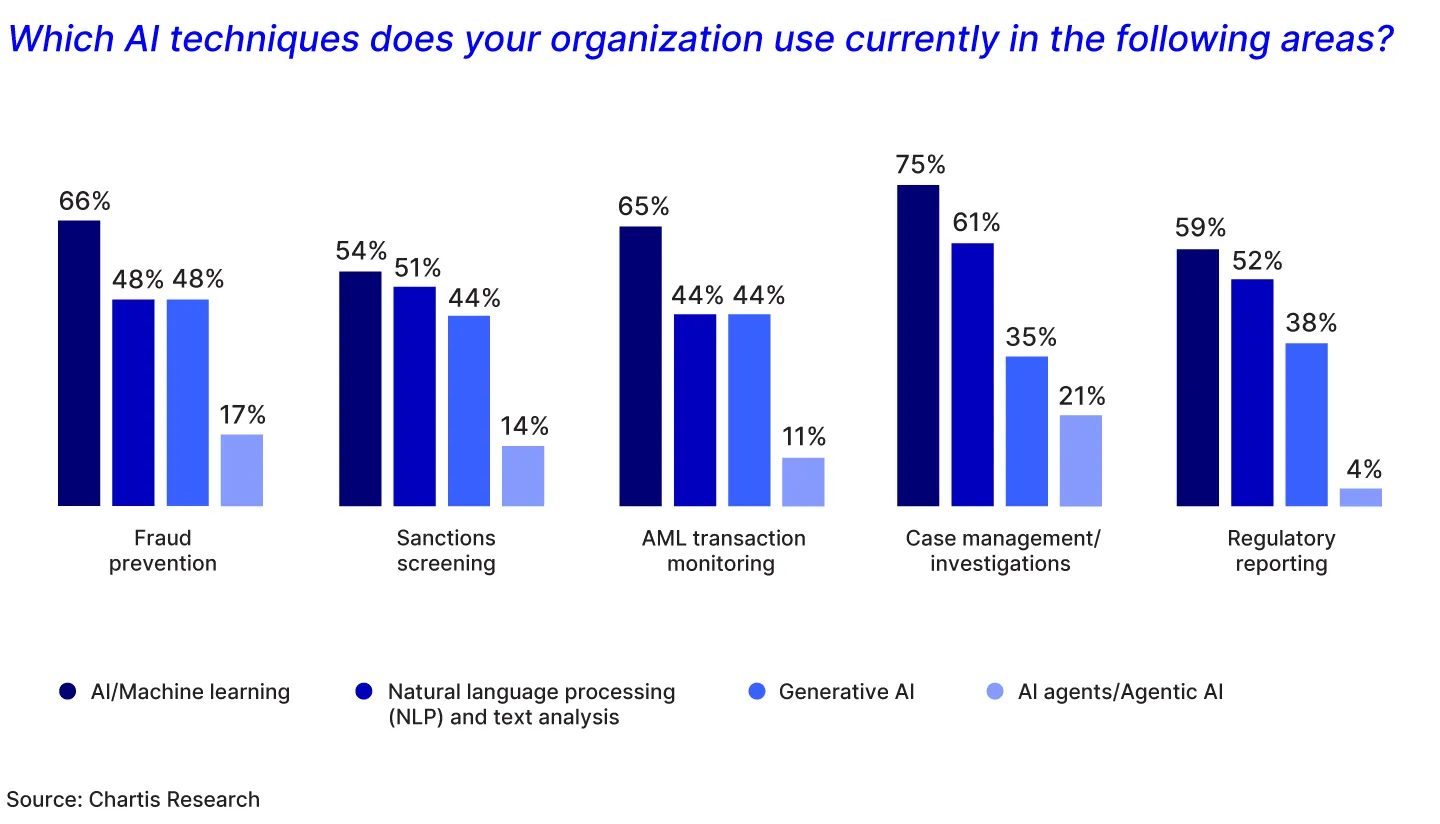
Machine learning (ML) remains the foundation technology across the FCC function:
- 75% use machine learning in case management and investigations
- 66% apply machine learning to fraud prevention
- 65% deploy it for AML transaction monitoring
Natural language processing ranks second, with strong adoption in case management and investigations (61%) and regulatory reporting (52%).
Although generative AI is still emerging, 48% of banks already apply it to fraud prevention, with sanctions screening and AML monitoring close behind at 44% each.
Agentic AI is still in its early stages, but it is already gaining traction in case management and investigations, with 21% of banks reporting active deployment.
Banks expect strong impact from AI technologies
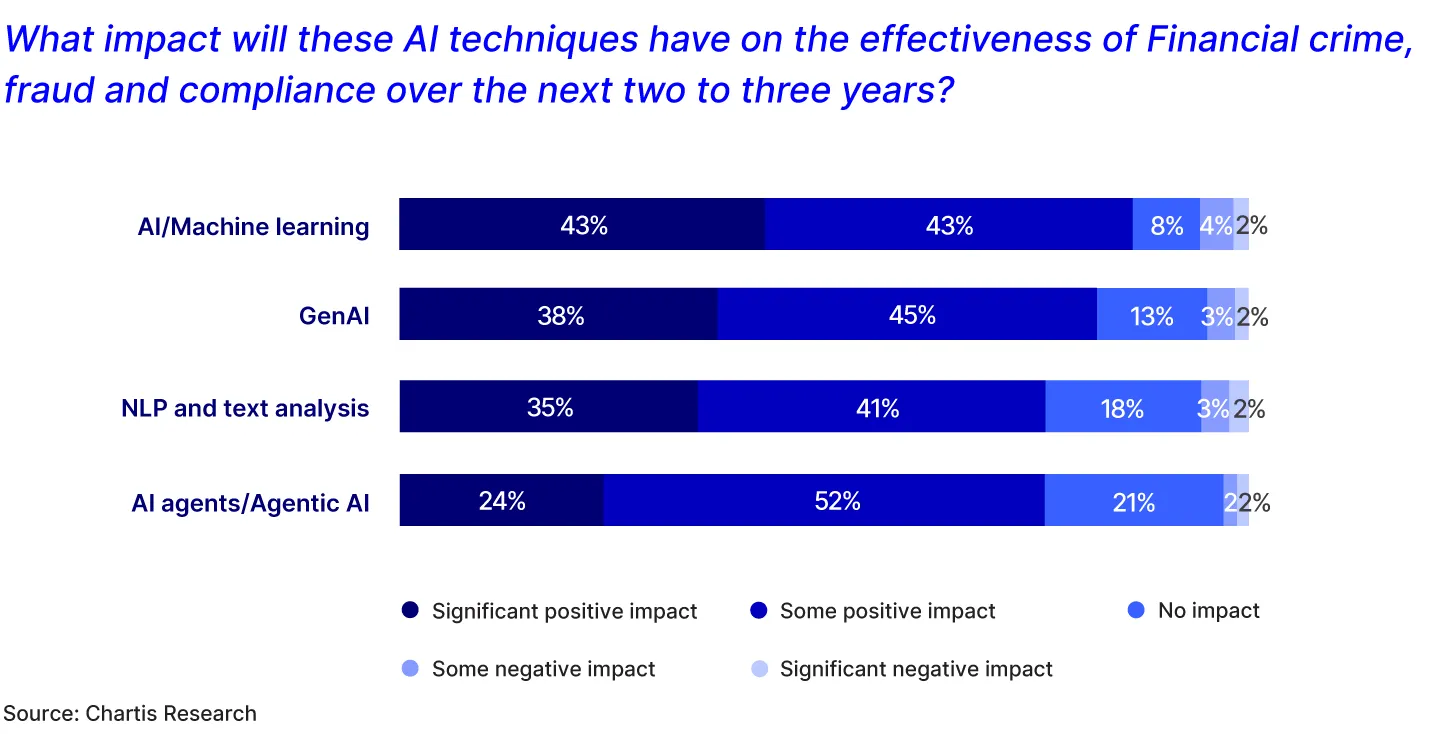
Compliance and risk leaders are optimistic about the future of AI in FCC.
86% expect machine learning to have a positive impact on financial crime, fraud and compliance over the next 2-3 years. Expectations for generative AI are similarly high, with 83% predicting positive outcomes.
Agentic AI, the technology at the earliest point in its adoption curve, is also expected to deliver a positive impact with 76% of respondents expressing optimism for the value it will bring.
→ Read the full Banking Edition here
→ Read the full Payment & FinTech Edition here